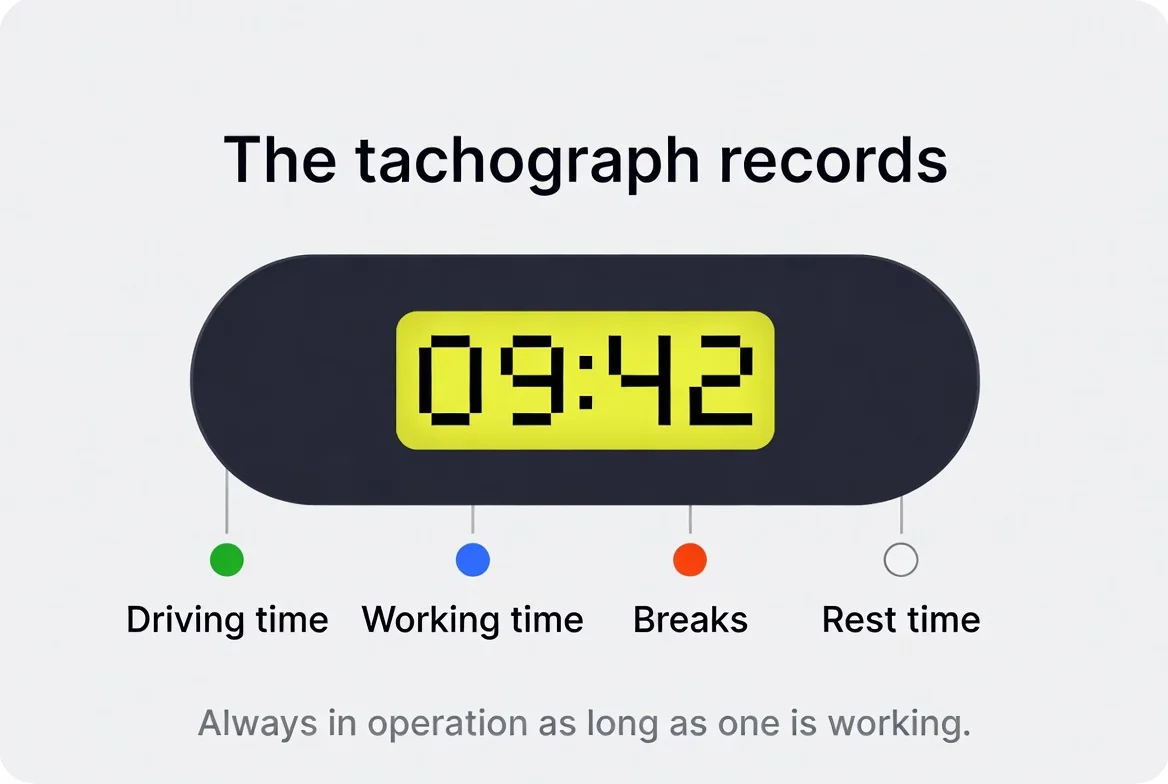
So that working and rest periods can be checked, a device in the vehicle records when the driver was driving, working and taking breaks: the tachograph. In addition there are the logbook and the summary sheet.
The tachograph
The most important obligations
As long as you are working and with the vehicle, the tachograph has to run continuously and be operated correctly.
Driving time, other working time and breaks have to be recorded cleanly and clearly identifiable for each driver.
For private journeys the break setting is selected, so that private trips can be distinguished from work.
At the request of the monitoring authority you have to open the device and provide information.
The record sheets
The insert sheets (or weekly bundles) have to be kept carefully and filled in: name, date, number plate and odometer reading. They are handed to the employer, normally by the first working day of the following week at the latest.
Moderne digital tachographs are also permitted; adapted recording rules then apply to them.
The logbook
Alongside the tachograph there is the logbook. In it the driver enters by hand how they have worked, driven and rested.
The logbook has to be carried at all times while driving and shown on request.
You may use only a single logbook – even if you drive for several employers.
The logbook is personal and cannot be passed on to others.
What is entered differs by type of driver: employed drivers mainly record working hours and the end of work, self-employed drivers mainly the driving times.
In certain cases the authority can exempt drivers from the logbook – for example if the company keeps proper daily reports or a fixed timetable is followed.
The summary sheet – keeping an overview
The employer has to check continuously that the time limits are respected. For that they keep a summary sheet for each driver with the key details:
Daily driving time as well as daily and weekly working time.
Overtime worked and compensated.
Rest days and free half-days taken.
Any work for another employer.
Self-employed drivers: For them the summary sheet only needs the daily driving time and the weekly rest day.
Who is responsible for what?
The employer has to …
organise the work so that the driver can keep to the time limits.
provide the driver with the logbook and the means for the tachograph.
keep a register of all drivers and protect the drivers’ personal data.
The driver has to …
report in good time if the time limits cannot be met.
keep the monitoring records correctly and hand them in on time.
report a defect in the tachograph as quickly as possible.
Keeping records, information, emergencies
Employers and self-employed drivers have to keep the records and documents for two years and show them to the monitoring authority on request.
In genuine emergencies – for example force majeure or to provide help – you may depart from the rules as far as necessary and as long as safety permits. The reason and extent have to be noted, however, and the deviation has to be compensated as soon as possible (at the latest by the end of the following week).
What happens in the event of breaches?
Anyone who breaches the time limits or the monitoring rules is punished with a fine . This applies, for example, if you do not let the tachograph run, falsify the records or give false information.
The boss is liable too: an employer who causes a breach or fails to prevent it can be punished in the same way as the driver.
Taxi theory
All taxi topics at a glance
Self-employed or employed, working hours and monitoring – simply explained for the taxi theory test.