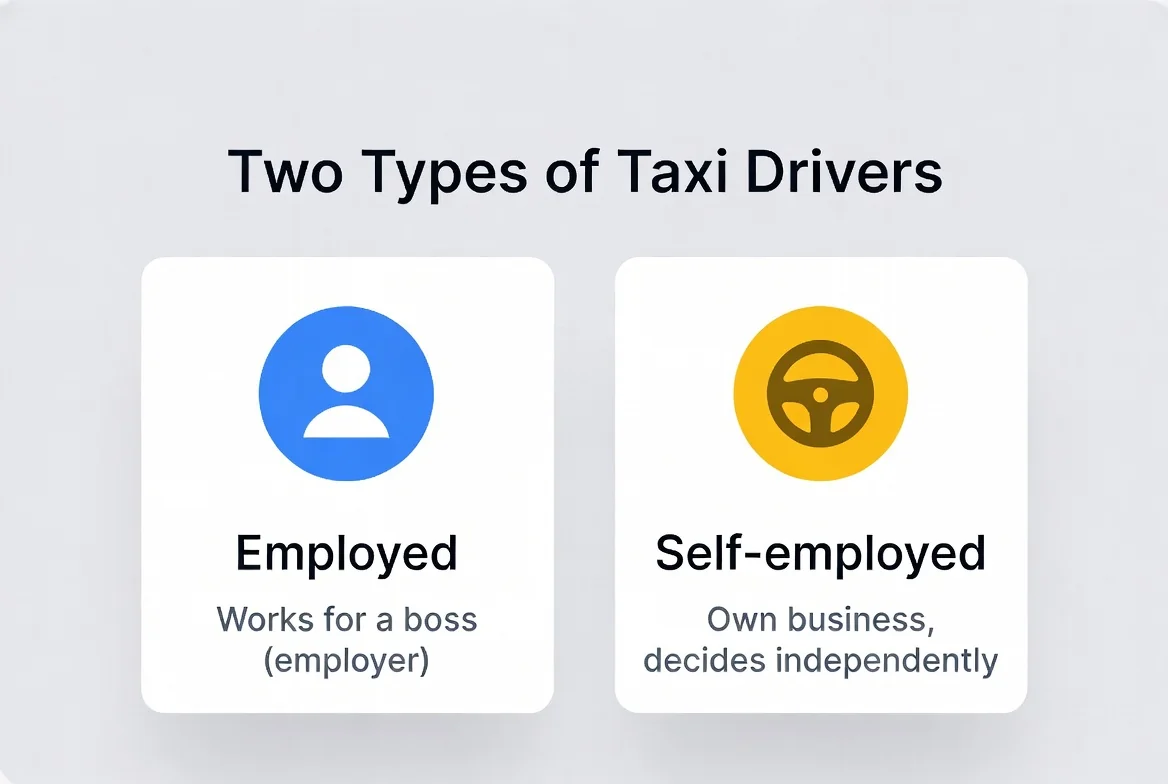
One distinction runs through the whole topic of working and rest periods in the taxi trade: it makes a difference whether someone is employed or works self-employed . Once you understand that, you have half of the ARV 2 test under control.
The two types of driver
The ARV 2 applies to everyone who transports passengers professionally in smaller vehicles – that is, the classic taxi trade and similar paid journeys. Two types of driver are distinguished:
Employed taxi driver: works for an employer. The focus is on the total working time.
Self-employed taxi driver: works on their own account. The focus is on the driving time behind the wheel.
Important: In case of doubt, what counts is how someone actually works – not what a contract says.
Working time and driving time – the difference
Two terms have to be kept apart, because different limits apply to them:
Working time: the entire time on duty – including waiting and standby.
Driving time: only the time actually spent driving.
Remember: For an employed driver the total working time counts. For a self-employed driver the focus is mainly on the driving time. You will find the exact figures under Working hours, driving time & rest periods.
The weekly rest day
This is where the difference is most obvious:
Employed drivers
Every week one rest day of at least 24 consecutive hours.
The daily rest period has to come immediately before or after it.
The rest day should fall on a Sunday or public holiday wherever possible. Anyone who has to work on Sundays is still entitled to at least 20 free Sundays or public holidays per year.
There may be no more than 12 working days between two rest days.
Self-employed drivers
Within two weeks two rest days of at least 24 consecutive hours each.
There may be no more than 12 days with work between two rest days.
For both: No work may be done on the rest day – and rest cannot be bought off with money.
Employed or self-employed – at a glance
Topic
Employed taxi driver
Self-employed taxi driver
Focus
Total working time (incl. waiting & standby)
Driving time behind the wheel
Weekly rest day
1 rest day every week (min. 24 h), Sunday where possible
2 rest days within 2 weeks (min. 24 h each)
Free half-day
Entitled to one free half-day per week
No separate free half-day provided for
Summary sheet (monitoring)
Full summary sheet kept by the employer
Summary sheet with driving time and rest day is sufficient
Logbook
With working hours and end of work
Mainly with driving times
Responsibility
Also with the employer
With the driver alone
Taxi theory
All taxi topics at a glance
Working hours, rest periods and the tachograph – simply explained for the taxi theory test.