Anyone who drives a taxi professionally may not work and drive for as long as they like. The ARV 2 clearly sets out how long you may be behind the wheel, when you have to take a break and how much rest you need. These rules protect the driver and everyone else on the road from fatigue.
How long may you work per week?
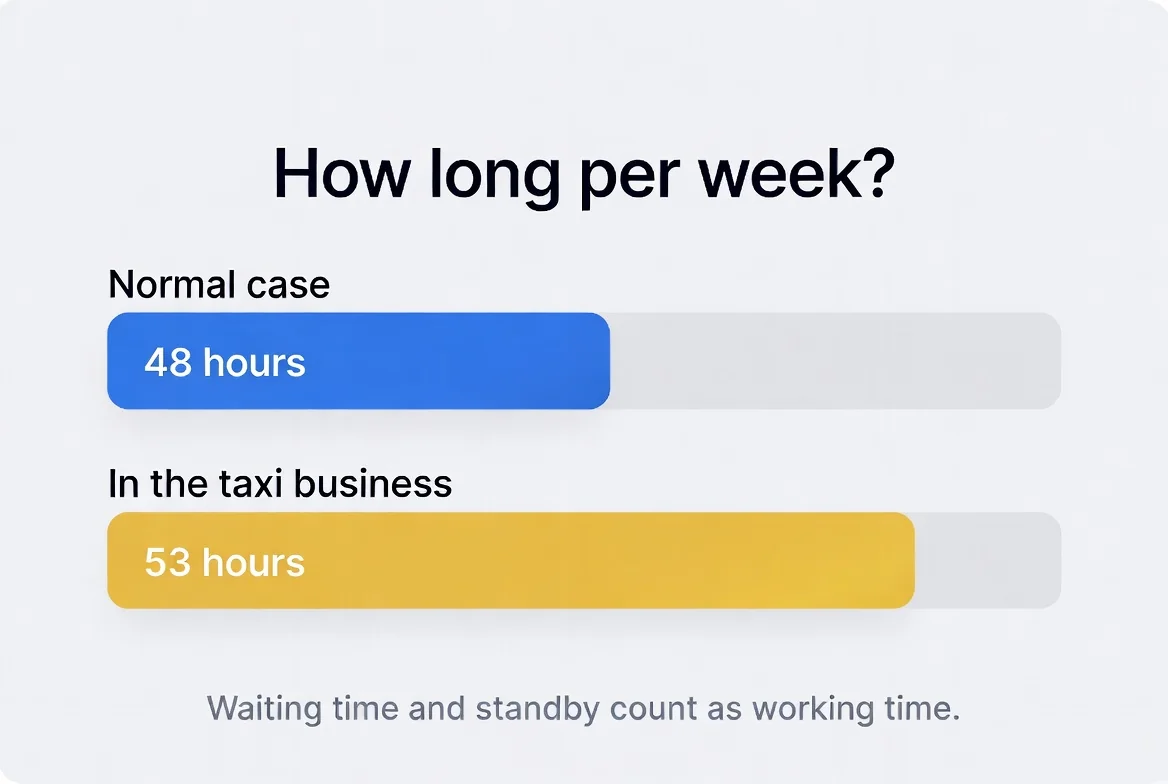
There is an upper limit on working time per week:
48 hper week in the standard case
53 hper week in a taxi company
Bear in mind: waiting time and standby count towards it. The limit is reached faster than you think.
If work is done in shifts, the shifts have to rotate after six weeks at the latest – unless the driver expressly agrees to a different arrangement.
Overtime – when it is more for once
The weekly limit may be exceeded in exceptional cases:
Up to 4 hours extra per week.
Where there is a particular need (e.g. seasonal peaks), 2 further hours möglich.
But no more than 208 hours of overtime in total per year.
Overtime is compensated – either with a wage supplement or with time off of at least the same duration. Compensation normally takes place within three months, at the latest within one year.
Remember: Even with overtime, the permitted driving time may never be exceeded.
How long may you drive?
For actual driving behind the wheel (the driving time) separate limits apply:
9 hmaximum driving between two daily rest periods
45 hmaximum driving per week
These driving-time limits are strict: they may not be exceeded even when you work overtime.
Breaks – catching your breath regularly
Break while driving
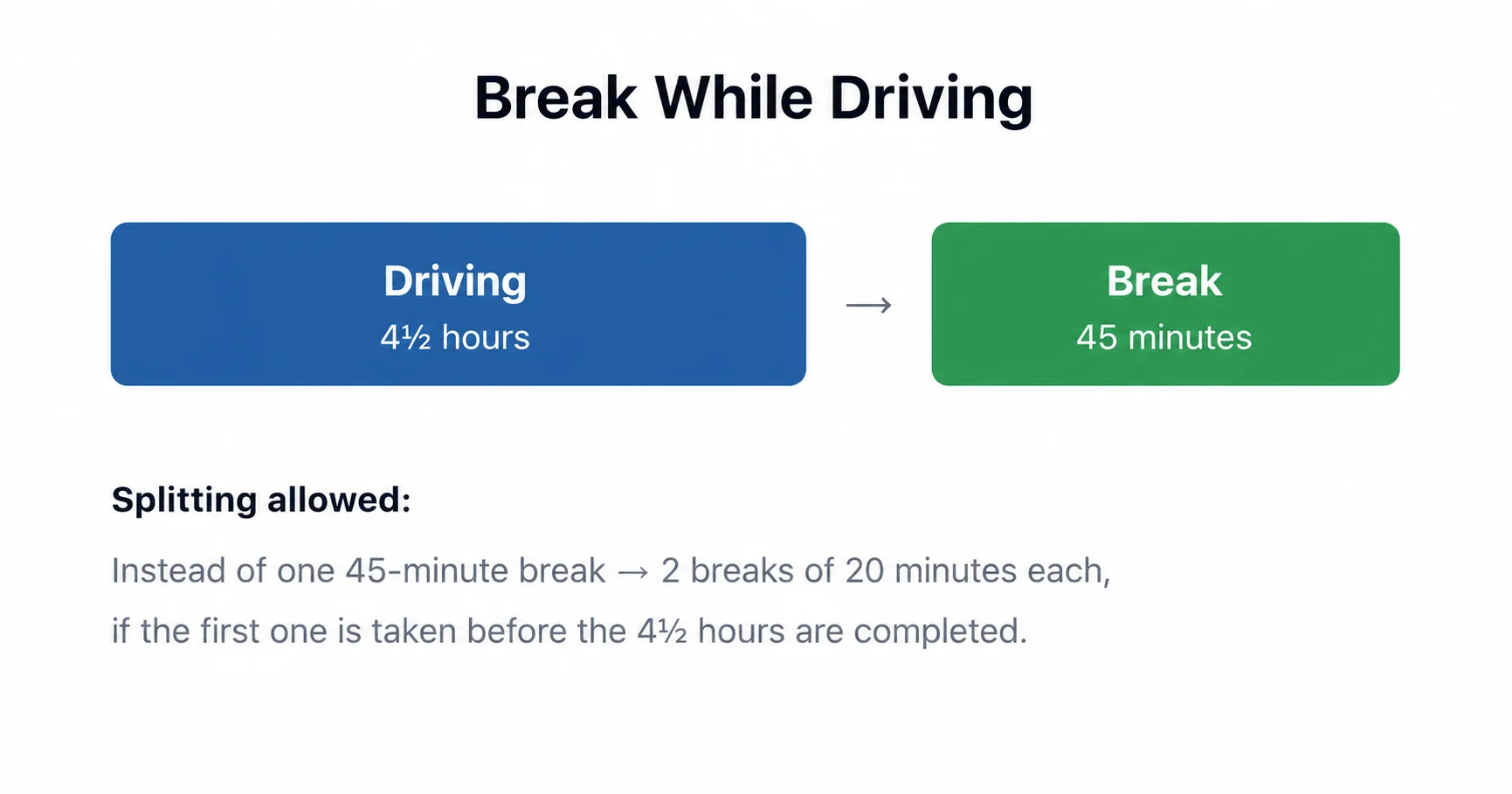
After 4½ hours of driving a break of at least 45 minutes has to follow. If you take the break earlier, 30 minutes or two breaks of 20 minutes each are enough. You may not drive during the break.
The break can be dropped if the daily rest period or the rest day starts immediately afterwards.
Break during work
At the latest after 5½ hours of work a work break is required. How long depends on the total working time that day:
Up to 7 hours of work: at least 20 minutes break.
Over 7 up to 9 hours: at least 30 minutes or two breaks of 20 minutes each.
Over 9 hours: at least 1 hour, or two breaks of 30 minutes each, or three breaks of 20 minutes each.
Breaks have to be spread so that there are never more than 5½ hours of work between two breaks.
Daily rest period
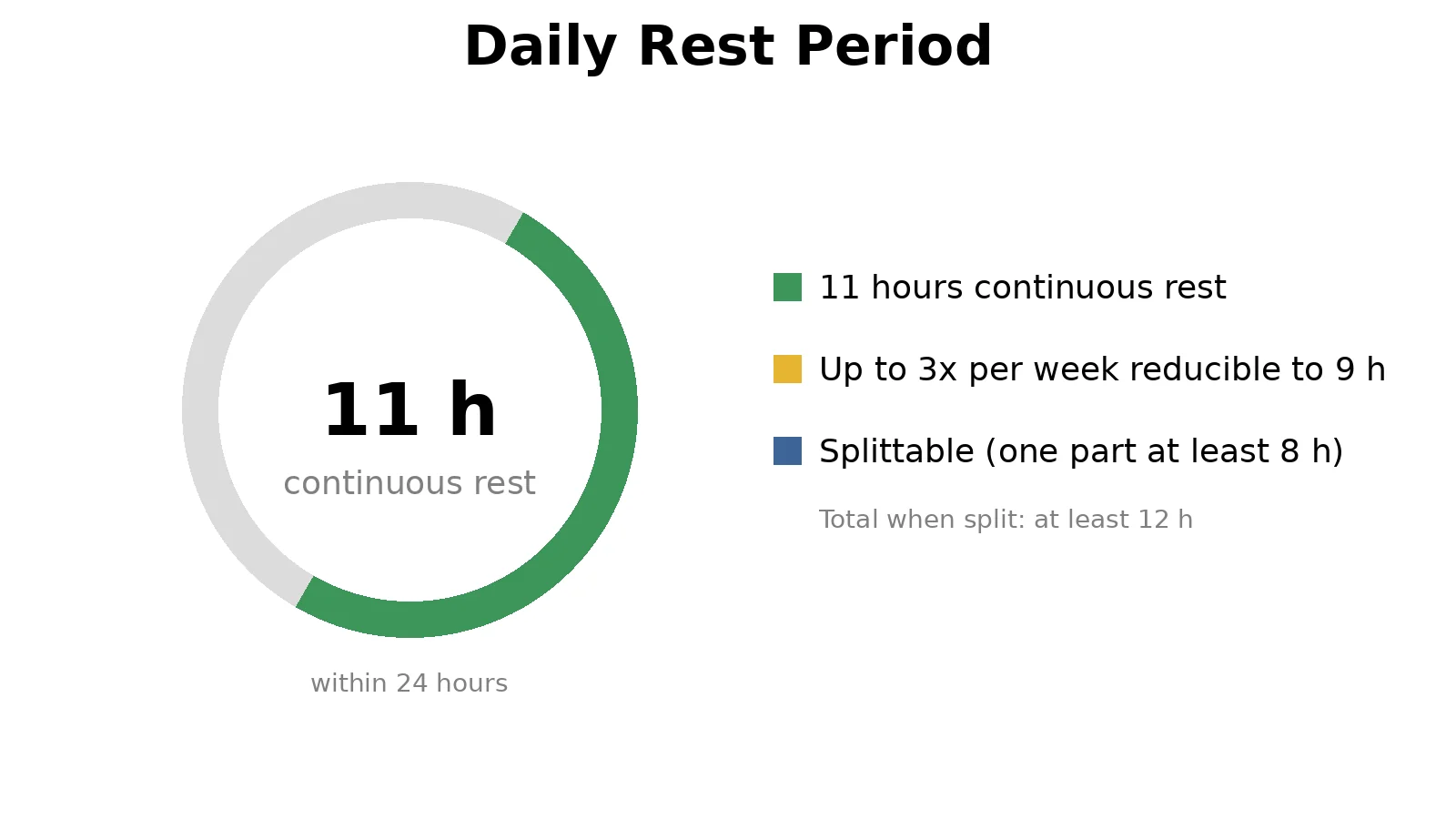
Within 24 hours you have to rest for 11 consecutive hours . This rest period may be shortened to 9 hours up to three times per week .
You may also split the daily rest period – into a maximum of three parts. In that case:
One part has to last at least 8 hours .
No part may be shorter than 1 hour .
Together they have to add up to at least 12 hours .
Important: No professional activity may be carried out during the rest period.
The free half-day
This rule mainly concerns employed drivers: anyone working more than five mornings and afternoons per week is entitled to a free half-day in addition to the rest day.
The free half-day lasts 5 consecutive hours between 07:00 and 18:00.
With the employer's consent, the half-days of up to four weeks can be collected and taken in one go.
Combining two half-days gives a free day from 07:00 to 18:00.
Rest cannot be bought off
The daily rest period, the weekly rest day and the free half-day may not be compensated with money or other benefits. Rest really has to be taken. The only exception is when the employment relationship ends.
Quick reference: the key figures
Weekly working time: 48 hours, 53 hours in a taxi company.
Driving time: 9 hours per day, 45 hours per week.
Break while driving: 45 minutes after 4½ hours.
Daily rest: 11 hours, reduced to 9 hours a maximum of 3× per week.
Overtime: a maximum of 208 hours per year.
Taxi theory
How is this monitored?
Find out how the tachograph records working and rest periods and what obligations you have.